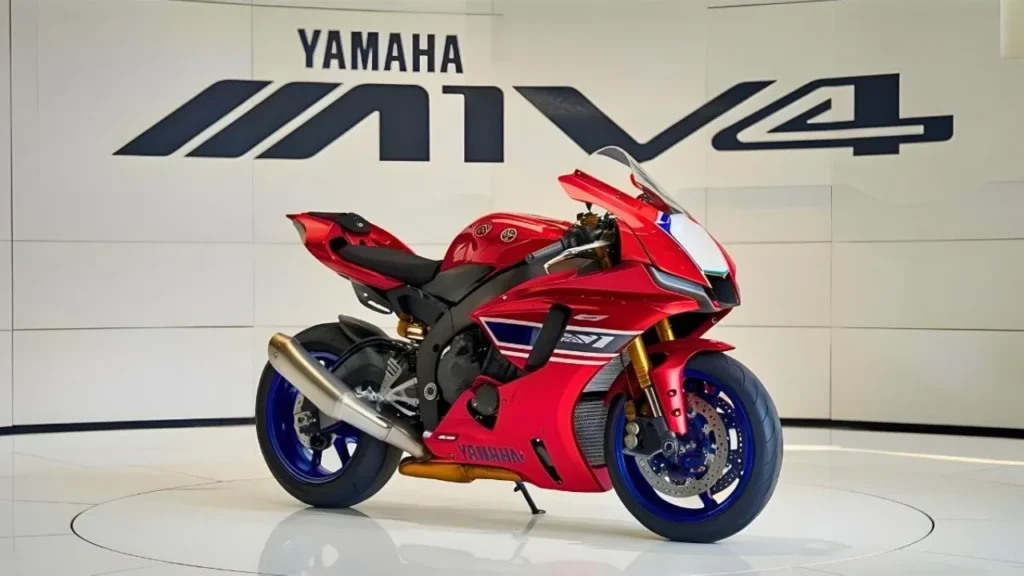
The 2026 Yamaha M1 V4 marks one of the most significant technical transformations in Yamaha’s MotoGP history. After decades of relying on its iconic inline-four philosophy, Yamaha has officially stepped into V4 territory, signaling a clear intent to adapt, compete, and evolve in an increasingly demanding MotoGP environment. This unveiling is not just a technical update, but a strategic reset aimed at long-term competitiveness.
For years, the Yamaha M1 earned respect for its balance, precision, and cornering stability. However, as MotoGP technology advanced, competitors using V4 engines gained measurable advantages in acceleration, aerodynamics integration, and overall adaptability. The introduction of the M1 V4 acknowledges these realities while opening a new chapter for Yamaha racing.

A Defining Moment in Yamaha’s Racing Evolution
Switching from an inline-four to a V4 engine represents a major philosophical change. Yamaha’s inline-four was celebrated for its smooth power delivery and rider-friendly nature, but modern MotoGP racing increasingly rewards compact engine layouts and higher power ceilings.
The 2026 Yamaha M1 V4 is not a rejection of Yamaha’s past success. Instead, it reflects a forward-looking approach shaped by years of research, simulation, and on-track testing. Engineers focused on retaining Yamaha’s traditional strengths while addressing areas where rivals have pulled ahead.
Inside the New V4 Engine Philosophy
At the core of the new M1 lies a newly developed V4 engine built specifically for MotoGP competition. The engine prioritizes improved top-end performance, stronger acceleration, and enhanced compatibility with advanced electronics systems.
Rather than chasing raw horsepower alone, Yamaha focused on a controlled and predictable powerband. Early development feedback suggests improved throttle response and consistent output across race distances, which is critical for tire management and rider confidence.
Chassis Development Without Losing Yamaha DNA
While the engine architecture has changed, Yamaha has worked carefully to preserve the handling qualities that made the M1 famous. The 2026 M1 V4 chassis has been redesigned to suit the V4 engine while maintaining strong front-end feel.
Frame geometry has been refined to balance agility and high-speed stability, especially during corner entry. Updates to the swingarm and suspension aim to manage the increased torque produced by the V4 engine.
Aerodynamics Designed for Modern MotoGP Racing
Modern MotoGP performance depends heavily on aerodynamics, and Yamaha has taken a clear step forward in this area. The 2026 Yamaha M1 V4 features a fully revised aerodynamic package with updated winglets and refined fairing profiles.

These components generate improved downforce while minimizing drag, helping reduce wheelie tendencies and improve straight-line stability. The aerodynamic design also enhances airflow efficiency, contributing to better cooling and consistent performance across varying track conditions.
Advanced Electronics and Rider Control
Electronics remain a decisive factor in MotoGP, and Yamaha has refined its systems to match the characteristics of the V4 engine. The bike benefits from updated traction control, engine braking management, and power delivery maps.
These systems allow riders to adapt quickly to changing grip levels, tire degradation, and fuel loads throughout a race weekend. The goal is to enhance rider input, not override it, ensuring confidence during both qualifying and race conditions.
What the M1 V4 Means for Yamaha Riders
The transition to the M1 V4 introduces a learning phase for Yamaha’s riders, but it also provides a more competitive foundation. Riders who previously struggled with straight-line performance may now find greater confidence when battling rivals on faster circuits.
Although adaptation is required, the new platform offers improved versatility and long-term development potential. With continued refinement, the M1 V4 could become a consistent front-running machine.
Fan Reaction and Its Impact on MotoGP
The unveiling of the 2026 Yamaha M1 V4 has generated strong reactions among MotoGP fans. Some view it as a necessary evolution, while others see it as the end of a distinctive era defined by inline-four engines.
Regardless of opinion, the M1 V4 reflects how MotoGP continues to push manufacturers toward innovation. Yamaha’s willingness to evolve strengthens competition and raises expectations for future seasons.
Disclaimer
This article is based on early information, industry reports, and official announcements available at the time of writing. Final specifications, performance figures, and design details may change as development progresses. Readers are advised to follow official Yamaha and MotoGP communications for the most accurate and up-to-date information.

Hi, I’m Shan, the Admin behind MKNK. I’m passionate about smartphones and automobiles, and I enjoy researching new technology, vehicle launches, and market updates. I started MKNK to share reliable information, practical insights, and easy-to-understand guides for everyday users. I focus on accuracy, originality, and real value so readers can trust what they read and make informed choices.